Why Street Photography Is Having a Video Revolution in 2026
Picture this: It is a grey Tuesday afternoon in Shoreditch. You are 45 minutes into a street session with your Fujifilm X100VI, you have got 12 frames you are excited about, and your Ray-Ban Meta glasses have been rolling the whole time. You get home, open your laptop, and the dread sets in — hours of scrubbing through footage, manually matching each photo to the moment in the video, keyframing title cards, nudging clips on a timeline. You do not publish the video. You never publish the video. It sits in a folder until you forget about it.
That experience, multiplied across tens of thousands of street photographers worldwide, has been the invisible wall between the photography world and the video revolution happening everywhere else. Until now.
In 2026, three things finally converged: the hardware got small and genuinely unobtrusive, the platforms built audiences starving for process content, and the software caught up with tools that make the edit — what used to be 3 hours of manual timeline work — take about 60 seconds. The wall is down. Street photography's video revolution is not coming. It is already here.
The Process Has Always Been the Story
Ask any dedicated street photographer what the most common question they receive is, and the answer is almost always a variant of: "How do you actually get these shots?" People want to understand the process — the walking, the watching, the waiting, the quick decisive movement, and then the long stretch of nothing before the next frame worth keeping.
The street photography audience on Instagram and YouTube has been consuming this kind of process content for years, mostly in the form of heavily-edited "day out shooting" vlogs that require the photographer to operate both a street camera and a separate vlog camera simultaneously. The compromise was always uncomfortable. You are either making photos or making a vlog. You rarely do both naturally at the same time.
What changed is the POV camera category. Specifically, the maturation of wearable cameras — glasses that record what you actually see — removed the compromise entirely. You shoot the way you always shoot. The glasses see what you see. You end up with genuine first-person documentary footage of your process without any of the self-consciousness or dual-camera awkwardness that plagued earlier approaches to process documentation.
The Hardware That Made It Practical
The Ray-Ban Meta Gen 2 smart glasses, released in late 2023, were the product that changed the equation for street photographers specifically. Not because of their video quality — the 1080p footage is good but not exceptional — but because of their invisibility. They look like regular Ray-Ban Wayfarers or Headliners. Nobody walking past you on a street knows you are recording.
That social invisibility is everything in street photography. The genre depends on subjects who are not performing for a camera. The moment someone spots your filming device, something changes in the environment around you. Glasses that look like glasses preserve the naturalness that makes street photography work.
The Ray-Ban Meta Gen 2 also pushed the form factor into mainstream consumer territory — the price dropped below $300, the battery life extended to around 60 minutes of continuous video (enough for a solid street session), and the footage quality improved enough to hold up on phone screens and at 1080p on YouTube. The glasses stopped feeling like a gadget and started feeling like a tool.
Alongside the glasses revolution, the action camera category made its own leap. The GoPro Hero 13 and DJI Action 5 Pro both introduced significant stabilization improvements in 2025, making clip-on mounting to a camera bag strap or chest harness produce footage smooth enough for professional content without any post-processing. The DJI Action 5 Pro in particular brought 10-bit color capture into a body smaller than a deck of cards — a genuine jump in footage quality that makes street process content look cinematic rather than documentary-functional.
The Camera Combinations Driving the Trend
The street photography community is not monolithic in its hardware choices, but a few pairings are driving the bulk of the video content appearing on platforms right now:
- Ray-Ban Meta Gen 2 + Fujifilm X100VI: The dominant combination for pure street photography. The X100VI's Classic Chrome JPEG output looks extraordinary in video context, and the glasses' eye-level footage creates an immersive first-person perspective that plays perfectly as Instagram Reels.
- GoPro Hero 13 + Leica Q3: The premium documentary approach. The Leica Q3's full-frame stills have a weight and presence that justifies the longer-form YouTube content this combination tends to produce. GoPro's HyperSmooth stabilization keeps the footage watchable during active walking.
- DJI Action 5 Pro + Ricoh GR IIIx: The minimalist kit. Both devices are genuinely small. The GR IIIx's snap focus and high-contrast output pairs visually with DJI's clean, slightly warm color profile.
- Ray-Ban Meta Gen 2 + iPhone 16 Pro: The all-Apple approach. Computational photography on the iPhone 16 Pro produces portrait-mode-quality street frames while the glasses capture the ambient context. The simplest two-device workflow possible.
Get the free POV Photography Cheat Sheet
Camera settings, EXIF sync tips, and export presets for every major POV camera and street camera combination — on one printable page. Join 1,000+ photographers getting weekly tips.
Free PDF, no spam. Unsubscribe anytime.
The Platform Shift: Where Process Content Lives in 2026
The platforms themselves have done as much to drive the video revolution as the hardware. Three distinct content formats have emerged across three platforms, each with its own audience and content logic.
TikTok: The 60-Second Street Hit
TikTok's native POV format — content filmed from a first-person perspective — was always a natural fit for street photography, but the community was slow to recognize it. That has changed sharply in the past 18 months. The hashtag #streetphotographypov has accumulated over 400 million views as of early 2026, driven largely by short-form clips showing the approach to a scene, the shot, and the resulting photograph in a single 45-to-60-second video.
The format that performs best on TikTok is extremely tight: no more than 5 seconds of walking/approach footage, a beat of anticipation, the moment of capture, and then the photograph revealed — ideally with the shutter click sound as a punctuation mark. What makes this work is the precision of the reveal. The photo appears exactly when it was taken in the footage, not approximately. That synchronization creates a satisfying micro-narrative in under a minute.
Creators like @tomabbottstreet (London-based, shooting with Ray-Ban Meta and Ricoh GR IIIx) and @francessullivanphoto (New York, Fujifilm X100VI and GoPro Hero 13) have built six-figure TikTok followings primarily on this format in the past year. The content is replicable by any competent street photographer — it requires no special editing skills, no voice-over, and no expensive production setup. Just a POV camera, a street camera, and something that can sync the two.
Instagram Reels: The 90-Second Process Story
Instagram Reels has settled into a sweet spot at 60-to-90 seconds for photography process content. The audience is slightly older and more technically engaged than TikTok — they want to see more of the session, understand the light conditions, get a sense of the neighborhood. They will watch a full 90-second Reel if the footage is compelling and the structure is clear.
The dominant structure for high-performing photography Reels in early 2026 is: opening establishing shot (10 seconds of walking footage), two or three photo reveals with ambient audio preserved, and a final card showing the day's best image in full resolution. Music is used sparingly — the most-viewed photography Reels increasingly use natural ambient sound rather than licensed tracks, partly because it performs better algorithmically and partly because it feels more honest.
The photographers winning on Instagram Reels right now tend to have strong editorial aesthetics that translate clearly to video — the look of a Leica Q3 or Fujifilm X100VI with Classic Chrome or Monochrome film simulation creates an immediately identifiable visual identity that makes the stills landing in the video feel like events rather than screenshots.
YouTube: Long-Form Process Documentaries
YouTube remains the home of long-form street photography content, and the genre has evolved significantly since the early "day in my life shooting street" format of the early 2020s. What performs now is more essayistic — 8-to-15-minute videos that use the session footage as evidence for a larger argument about photography, seeing, or urban life.
The photographers building durable YouTube audiences in this space — people like Matt Day, James Maher, and a wave of younger creators coming up through the Fujifilm community — combine genuine photographic knowledge with production quality that requires real planning. The POV footage is not filler between talking-head segments; it is the primary evidence for the ideas being explored. Street photography YouTube in 2026 is closer to visual essay than vlog.
The Editing Problem That Was Holding Everyone Back
Here is the thing that the platform enthusiasm tends to obscure: until very recently, actually making this content was brutally time-consuming. The manual editing workflow for a single 10-minute street session looked something like this.
Transfer footage from your glasses or action camera to your laptop. Import your RAW files from your street camera. Open Premiere Pro or Final Cut Pro. Create a new sequence at the correct aspect ratio. Drop the video onto the timeline. Now the real work begins: scrub through the footage until you find the moment that corresponds to your first photo. Note the timestamp. Find the photo in your import folder. Drag it onto a photo track. Position it. Set the duration. Repeat 20, 30, 40 times depending on how many frames you shot.
Then add titles. Choose a font, set the size, type the location, kerning, position, color. Add a dissolve. Repeat for every card. Export. Realize the aspect ratio is wrong for Instagram. Adjust and re-export.
A competent editor doing this workflow took 2-to-4 hours to produce a single 10-minute video. An inexperienced editor could spend an entire evening on it. The math simply did not work for most photographers — the effort required was entirely disproportionate to the platform reward of a single Instagram Reel or TikTok.
That is the wall that was keeping street photographers out of the video revolution. And it is the wall that automatic EXIF sync finally breaks down.
Download POV Syncer Free — Create your first POV video in 60 secondsHow Automatic EXIF Sync Changes the Math
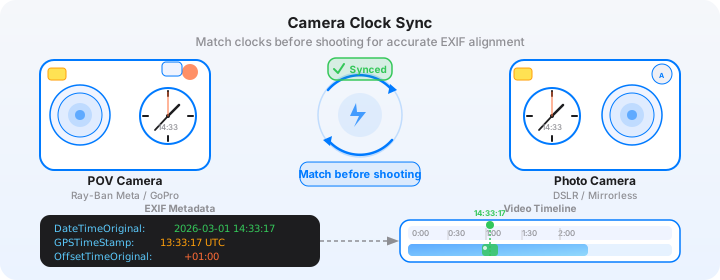
Every photograph taken on a modern camera — whether a Fujifilm X100VI, a Sony A7C II, a Leica Q3, a Ricoh GR IIIx, a Nikon Zf, or an iPhone — writes a timestamp to its EXIF metadata at the moment of shutter actuation. That timestamp is accurate to the second, and in many cases to sub-second precision via GPS or network time.
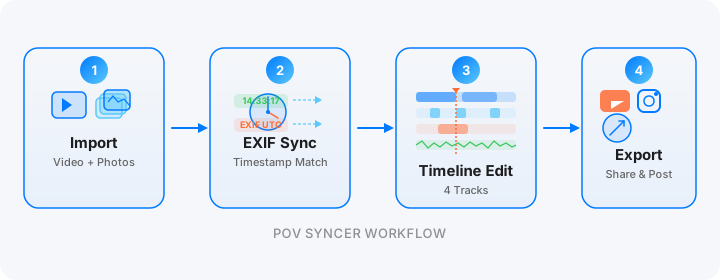
POV cameras like Ray-Ban Meta glasses and GoPro devices write a corresponding start timestamp to their video files. The frame rate is fixed and consistent — 30fps or 60fps depending on your settings. This means that for any photograph taken while the video was rolling, you can calculate the exact video frame it corresponds to: (photo timestamp minus video start timestamp) multiplied by frame rate equals frame number.
That is the entire algorithm. It is elegant in its simplicity, and it is what POV Syncer does automatically the moment you import your footage and photos. The app reads the EXIF timestamps from your photos, reads the start time from your video file, calculates the frame-accurate position of every photo, and places them on the timeline. What took hours of manual scrubbing and drag-and-drop is done in seconds.
The Real-World Workflow in 2026
The workflow that was once a 3-hour desktop editing session now fits on your phone during the train ride home from a shooting session. Import the glasses footage from the Meta View app. Import the JPEGs from your camera via a card reader or camera connection cable. Open POV Syncer. Tap import. Watch the app automatically place your photos on the timeline, matched to their precise moments in the footage.
From there, you trim the clips you want to keep, add a title card with location and time, optionally add a brief AI-generated narration or your own voice recording, and export at the aspect ratio for your chosen platform. The full process, start to finish, takes under 10 minutes for a tight 60-to-90-second cut. For longer YouTube content, you might spend 20-30 minutes on structure and narration. But the tedious timeline placement — the part that used to consume hours — is entirely automated.
This is the practical change that has unlocked the street photography video revolution. It is not a cultural shift or a platform algorithm change. It is simply that the time cost dropped from hours to minutes, and suddenly the math works.
What This Means for Street Photography Culture
The shift from photography-only to photo-plus-video has implications that go beyond content creation metrics. It changes what street photography is and how it is understood by audiences who did not grow up with the genre's traditional reference points.
The Process Becomes Legible
Street photography has always suffered from a perception problem: the best images look effortless, which makes the skill required to produce them invisible to non-practitioners. A Henri Cartier-Bresson frame looks like something that just happened. The thousands of hours of street walking, the spatial intelligence, the anticipation, the dozens of failed frames before the decisive one — none of that is visible in the final print.
POV video makes the process legible for the first time. Audiences watching a process video understand viscerally that street photography is an active, skilled, physically demanding practice. They see the waiting, the missed shots, the moments of genuine recognition when a scene comes together. This comprehension builds a different kind of audience relationship — one based on understanding and respect rather than simple aesthetic admiration.
A New Generation of Street Photographers
The photographers picking up the genre through TikTok and Instagram Reels in 2025 and 2026 have a fundamentally different relationship with the medium than the photographers who came up through Flickr, Tumblr, or traditional photobooks. They expect to document and share their process, not just their results. The camera is part of a content system, not just an image-making tool.
This is not a degradation of the genre, despite what some traditionalists argue. The photographers doing the most interesting work in 2026 are using the video documentation as a constraint and a discipline — the knowledge that your process will be visible creates a different quality of attention during the shoot. You are not just looking for photographs. You are thinking about the narrative of the session.
Street Photography Finds a Sustainable Business Model
Perhaps most practically: video content allows street photographers to build audiences that support their work in ways that portfolio photography alone rarely could. The educational value of process documentation — the implicit instruction in every video about how to see, how to approach, how to edit — creates a legitimate case for Patreon support, workshop enrollment, and product partnerships that pure image-posting does not.

Want settings cheat sheets for 20+ camera combos?
Join 1,000+ photographers getting weekly tips on POV video for every major camera combination — from Ray-Ban Meta plus Fujifilm X100VI to GoPro plus Leica Q3. Free, practical, and specific.
Free, no spam. Unsubscribe anytime.
The Tipping Point: Why 2026 Specifically
Trends rarely have clean start dates, but 2026 has a legitimate claim to being the tipping point for street photography video. A few specific factors came together in the past 12-18 months that moved the trend from "interesting experiment for early adopters" to "mainstream practice for working photographers."
Smart Glasses Hit Mass Distribution
The Ray-Ban Meta product line went into significantly wider retail distribution in late 2025, appearing in optical shops and consumer electronics chains globally. The glasses became a product that photographers could try on, buy, and return without friction. The friction of specialty hardware — something you had to order online and commit to before understanding how it would fit into your workflow — was removed. The installed base of smart-glasses-wearing street photographers grew rapidly as a result.
Platform Algorithm Changes Rewarded Process Content
Both Instagram and TikTok made algorithmic changes in 2025 that specifically rewarded "educational" and "behind the scenes" content over pure aesthetic posts. The practical consequence was that photography process videos — which perform well on both of these dimensions — started receiving significantly better organic distribution than a static portfolio post on the same account. The platform incentive aligned with the creative opportunity for the first time.
The Community Self-Reinforced
Once a critical mass of photographers started making this content and finding that it performed well, the community effect kicked in. Photography communities on Reddit, Discord, and dedicated forums began sharing their setups and workflows. The knowledge of what works — the tight 60-second format, the ambient audio, the photo-reveal structure — diffused rapidly. New practitioners had templates and examples to learn from rather than having to figure out the format from scratch.
Getting Started: Your First Street Photography Video in 2026
If you are a street photographer who has been watching this trend and wondering whether it is time to try it, the practical barrier has never been lower. Here is the minimum viable setup and workflow.
The Minimum Viable Hardware
You do not need Ray-Ban Meta glasses to start. If you already own a GoPro or DJI action camera, mounting it to your bag strap or using a clip mount at chest height will give you usable POV footage for a first attempt. The key is that the camera is hands-free and recording while you shoot with your main camera.
Your existing street camera — whatever it is, as long as it writes EXIF timestamps — is compatible. Fujifilm, Sony, Canon, Nikon, Ricoh, Leica, even iPhone — POV Syncer reads EXIF data from all of these natively. The only requirement is that your camera's clock is set accurately. Match it to your phone's time before the session.
The Session Discipline
A few small changes to how you shoot will make the video significantly better. Start the POV camera recording before you take your first photo of the session, not during. Keep the POV camera pointed roughly where you are looking — avoid looking at the ground during interesting moments. And resist the urge to chimp after every shot; the video of you staring at your camera's rear screen is deadweight in the edit.
Shoot more frames than you normally would. On a session intended for video documentation, a higher photo count gives you more reveal moments in the edit and more choices. The X100VI, Ricoh GR IIIx, or Sony A7C II will handle a high-volume shoot without complaint.
The 10-Minute Edit
Import everything to POV Syncer. Let the automatic EXIF sync do its work — your photos will appear on the timeline matched to their moments in the footage in seconds. Trim the video to your best 60-90 seconds. Add a simple location title at the open. Export in 9:16 for TikTok and Reels, 16:9 for YouTube. Done.
That first video will not be your best. But it will exist, which is more than the version that required 3 hours of desktop editing ever managed.
Explore more about the street photography POV process, learn the EXIF sync system in detail, and see the full POV Syncer feature set to understand what is possible. For pricing details, the free tier gives you enough to complete a first video before committing to Pro.
The Revolution Is Personal
Street photography is having its video revolution not because the medium demanded it, but because the tools finally caught up with the desire. Photographers have always wanted to share their process. They have always known that the story behind the image is as interesting as the image itself. What they lacked was a workflow that made the documentation sustainable — something that cost minutes rather than hours per session.
That workflow exists now. The cameras are small, the platforms are hungry, the audiences are waiting, and the editing grind that used to stand between the session and the published video has been compressed into automatic EXIF sync that runs in seconds. The only thing left is to walk out the door with your glasses on and your camera in hand.
Join the revolution — your first POV video takes 60 seconds
Download POV Syncer free and turn your next street session into a compelling process video. Automatic EXIF sync, 15 premium fonts, AI-powered narration, and one-tap export to any platform.
Or get the free cheat sheet with settings for every major camera combo:
Free PDF, no spam. Unsubscribe anytime.